

I live in a Kenneth Koehler house in Seward Park, and I sold one of the most widely covered midcentury listings in Seattle last year. So this page is part history, part field notes, and part buyer's checklist: who Koehler was, what living in one of his houses is actually like, and what I tell clients to look for when a midcentury home in this city catches their eye.
Who Was Kenneth Koehler?
Kenneth E. Koehler is not a household name, even among Seattle design people, and he should be better known than he is. Born in Columbus, Ohio, in 1920, he flew B-17s in the Second World War, earned a Purple Heart, and finished his architecture degree at the University of Illinois in 1948. He moved to Seattle that same year, worked briefly for George W. Stoddard, and opened his own firm in 1950.
He built that practice in the Rainier Valley, and he was rooted in it: he served as president of the Rainier Chamber of Commerce, and the University of Washington's Pacific Coast Architecture Database places his practice squarely in the South End. He also chaired the AIA's Home of the Month committee from 1956 to 1960. That was the Seattle Times/AIA Home of the Month program, the same one that, a year after his term ended, featured the Van Slyck & Callison house I sold.
The work
Koehler's catalog is mostly residential, and it is broader than his reputation. The Docomomo WEWA record lists:
- 01Custom houses from Normandy Park to Issaquah, starting with the Francis Baarley House in 1953.
- 02Parade of Homes spec houses: two for builder John Conner in 1958 and one for Norval Latimer in 1962, plus design work for Lindal Homes in 1964.
- 03A run of apartment buildings, among them the Seward Park Apartments in 1958 and Brighton Place in 1968.
- 04Civic work, including the Rainier District Eagles Lodge in 1959 and park restroom buildings for the Seattle Parks Board in 1964, from Lakewood to Haller Lake and Green Lake.
He moved to Poulsbo in 1970, kept working and serving on local boards there, and died in 1981.
The Vista '63 house
The design that made his name was a showhouse. For the 1963 Seattle home show, Koehler built the Vista '63 inside the Washington Coliseum at Seattle Center: partly prefabricated, put up in ten days, and built as two A-frames, a small one over the entry and a large one sheltering most of the rest of the house. It was the sculptural, World's Fair-era modernism Seattle was in love with the year after the fair.
After the show it was taken apart and moved. Koehler bought it and made it his family home, and it still sits in Seward Park: a four-bedroom tri-level that Seattle magazine featured in 2015 with its original Rangaire intercom and basket-weave paneling intact. It is a private home, so admire it from the street.
Living in a Koehler House
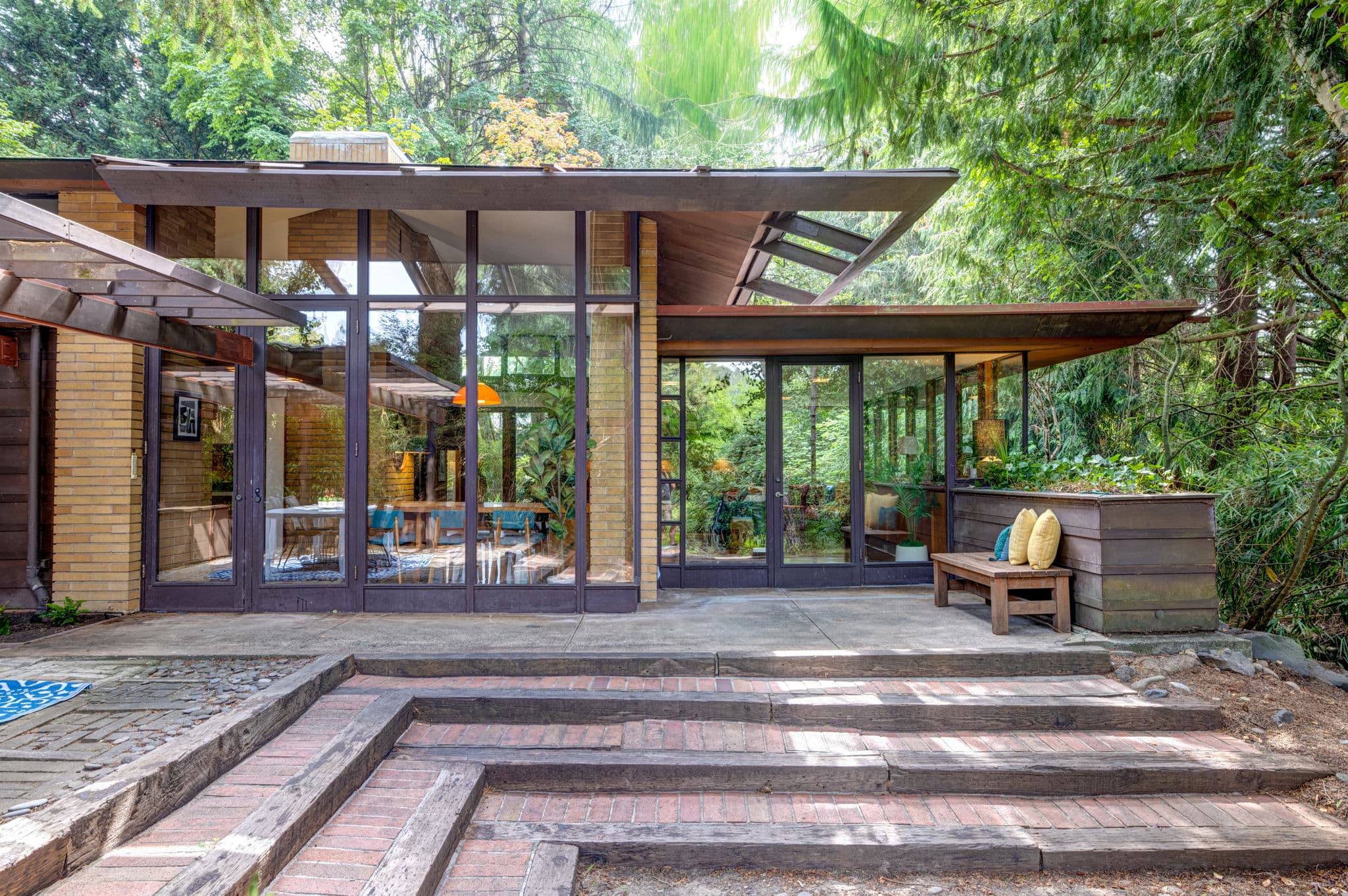
My house sits on a quiet Seward Park street, about the same distance from Chuck's Hop Shop as it is from Lake Washington, which is about as good as a location gets. It is quintessential midcentury modern: a low-pitched roof with deep overhangs, and a massive window wall that looks out to the lake.
What sold me is what sells most people on these houses. The window wall changes what the house is: the lake and the sky are part of the room, and the light moves through the day in a way a conventional house never manages. The overhangs are not decoration either. They keep the summer sun off that glass and let the low winter light in, which is the kind of thinking you only notice once you live with it.
My favorite thing about the house is the front doorknob. It sits dead center in the middle of a massive solid wood door. That is a terrible place for leverage, and getting the door open takes more effort than it should. It is also one of the coolest details I have ever seen on a house, and it is still working, barely, after about 65 years. I am going to be sad when it finally gives out.
That doorknob is the whole midcentury bargain in miniature. These houses were designed by people with strong ideas, and some of those ideas ask something of you. If the trade sounds charming rather than annoying, you are probably the right buyer.
The Van Slyck Sale
In 2025 I listed 4030 NE 104th St, a 1961 Van Slyck & Callison house on Thornton Creek in Meadowbrook. We marketed it as architecture first, and it got the kind of attention most listings never see: Dwell covered it, Zillow Gone Wild picked it up, and it drew multiple offers on review day. You can see how it played out on Instagram, in the reel and the story highlights.
I wrote up what made that sale work, and what it means for anyone selling a midcentury modern home in Seattle, separately. The short version for buyers: the design-minded buyer pool is real, it moves fast, and when an original lists properly you will not be the only one who noticed.
What to Look for When Buying a Midcentury Home in Seattle
Most of these houses are 60 to 75 years old, and they were built with materials and ideas that behave differently from a Craftsman or a new build. None of this is a reason to pass on one. It is a reason to inspect with the right questions.
Single-pane glass
Window walls are the point of the house, and most originals are single-pane, often in aluminum or wood frames. Expect condensation in winter, real heat loss, and a house that is cooler near the glass. Look for failed seals, rot at the bottom of wood frames, and panes that are cracked or fogged. Replacing big custom panes is expensive, and a generic replacement window can wreck the look. Price the options before you assume the answer is a full swap.
Flat and low-slope roofs
Low-pitched and flat roofs are signature midcentury, and in Seattle's rain they are the first thing to ask about. Find out what the roofing is and how old it is, and look hard at how water gets off it: scuppers, gutters and drains need to be clear and working. Many of these houses have the roof deck as the ceiling, with exposed beams and little or no insulation, so ask whether insulation was added on top at the last re-roof. Stains on a wood ceiling are worth understanding before you close.
Radiant heat
A lot of Seattle midcentury homes were built with radiant heat, either electric cables in the ceiling or hot-water pipes in a concrete slab floor. It is quiet, even and comfortable when it works. Have every zone tested, ask what has been repaired, and understand that a leak in an in-slab system is hard to find and harder to fix. With radiant ceilings, nothing gets nailed or screwed into that ceiling without knowing where the cables run.
Post-and-beam quirks
Post-and-beam construction is what makes the open plans and walls of glass possible, and it has its own weak points. Exposed beam ends that run out past the glass to the overhangs take weather for decades, so check them for rot. Walls of glass also leave less solid wall to resist an earthquake, so ask whether the house is bolted to its foundation and whether any seismic work has been done. Expect fewer interior walls and more exposed structure, which makes rewiring, adding ducts or moving a wall more involved than in a conventional house.
The usual Seattle checks, for a house this age
- 01A buried heating oil tank, and whether it has been decommissioned or removed.
- 02A scope of the side sewer, the line from the house to the street.
- 03The original electrical panel and wiring, which may be ungrounded or undersized for modern use.
- 04Galvanized supply pipes, if they have not been replaced.
- 05Asbestos in materials like old vinyl floor tile, its adhesive, acoustic ceilings and duct wrap, which only matters if you plan to disturb them.
South End Midcentury Worth Knowing About
The North End gets most of the attention, but Southeast Seattle has a deep bench of postwar design, much of it on view lots above the lake. A few to know about, all private homes, so please enjoy them from the sidewalk:
- 01The Dowell House in Seward Park, by Paul Hayden Kirk, 1953. One of Kirk's best houses, it won an AIA Seattle Honor Award in 1957.
- 02The Ota Residence in Rainier Beach, by Benjamin F. McAdoo, 1955 to 1956. McAdoo was the first licensed Black architect in Washington, and the house blends midcentury modern with traditional Japanese design: shoji doors, a tokonoma alcove and a deck over a wooded slope.
- 03The Vista '63 in Seward Park, Koehler's showhouse, described above.
- 04Koehler's Seward Park Apartments, from 1958, a reminder that South End modernism was not only custom houses.
Beyond the landmarks, the everyday stock is the real opportunity. Seward Park has midcentury ramblers on its interior streets, Lakeridge has individually designed midcentury moderns on its slopes, and much of Rainier Beach dates from the same era. Many of these homes never get marketed as midcentury at all.
Looking for a Midcentury Home?
The right midcentury house rarely shows up with the words in the listing, and the good ones do not last. I watch for them across the city, and I have worked both sides: I sold the Van Slyck, and I represented buyers who came to me looking specifically for a midcentury home and bought a 1964 house in View Ridge. If you are hunting for one, or you own one and are wondering what it is worth, I would be glad to talk.
Quick answers
- Who was Kenneth Koehler?
- Kenneth E. Koehler (1920 to 1981) was a Seattle architect who built his practice in the Rainier Valley. A B-17 pilot in the Second World War, he came to Seattle in 1948, opened his own firm in 1950, and designed houses, apartment buildings and civic projects across the South End and the Eastside before moving to Poulsbo in 1970. His best-known design is the Vista '63 house, built inside the Washington Coliseum for the 1963 home show and later moved to Seward Park.
- What should I inspect when buying a midcentury modern home in Seattle?
- Focus on the things these houses do differently: the age and drainage of a low-slope roof, the condition of single-pane glass and its frames, whether radiant heat works in every zone, rot at exposed beam ends under the overhangs, and how the house is braced and bolted for earthquakes. Add the usual Seattle checks for a house this age: a buried oil tank, a side sewer scope, older wiring and plumbing, and asbestos-containing materials.
- Are there midcentury modern homes in South Seattle?
- Yes, and more than most people expect. Seward Park, Lakeridge and Rainier Beach all have individually designed postwar houses on view lots, including work by Kenneth Koehler, Paul Hayden Kirk and Benjamin F. McAdoo. Many never get marketed as midcentury at all, which is why it pays to have someone watching for them.
- Should I replace single-pane windows in a midcentury house?
- Not by reflex. The thin frames and huge panes are a large part of what makes the house look the way it does, and a generic replacement window can change that badly. Interior storm panels, selective replacement of failed units, and thin-profile glazing are all options worth pricing before you commit to a full swap.