

Greenwood is the North Seattle neighborhood that behaves like a small town with a big city attached. It has a proper main street on Greenwood Avenue N, the kind with a library, a theatre and a long run of places to eat; buses running frequently in four directions; bungalow streets that turn quiet a block off the arterial; and a housing mix that has kept the door open for buyers who found Ballard and Phinney Ridge closed. I represented the buyer of a new townhome along Holman Road here, and this is the neighborhood as I would explain it to a client.
The Lay of the Land
Greenwood sits north of Phinney Ridge and Woodland Park, with Aurora Avenue N as its hard eastern edge and Crown Hill to the west past 8th Avenue NW. The southern boundary floats, because Greenwood and Phinney Ridge blend into one another along Greenwood Avenue and plan their events together; most people put the line somewhere around N 80th Street, where the old streetcar used to turn around. The northern edge is N 105th Street and Holman Road, beyond which Broadview and Bitter Lake begin.
The center of everything is the intersection of Greenwood Avenue N and N 85th Street. The commercial district runs along Greenwood Avenue in both directions from there, and the residential grid spreads out on either side. Two geographic facts shape daily life. First, the neighborhood is flat, which in Seattle is rare and worth money: walking and cycling here do not involve hills. Second, it sits on the old Greenwood bog, a peat deposit the neighborhood was built over a century ago, which matters when you inspect a house and which I come back to below.
Greenwood Avenue Is the Point
The reason to live in Greenwood rather than in the neighborhoods around it is the street. Greenwood Avenue between roughly N 80th and N 90th is a genuine main street, built out in brick and stone in the 1920s and 1930s and still working the way it was meant to.
- 01The Greenwood branch of the Seattle Public Library, a branch since 1928, in a light, much-loved 2005 building at the heart of the strip.
- 02Taproot Theatre, a professional company that has anchored the corner of N 85th for decades and survived a fire in 2009 to come back stronger.
- 03Restaurants, bars, bakeries and coffee at a density most Seattle neighborhood streets lost years ago, and a run of independent shops between them.
- 04The annual Greenwood Car Show on the last Saturday in June, which has closed the avenue to traffic every year since 1993, and the Greenwood Seafair Parade in July.
None of that requires a car, and most of it is within a fifteen-minute walk of the houses on either side.
Parks and Getting Outside
Greenwood's own parks are neighborhood-scale rather than regional. Greenwood Park, a few blocks east of the avenue at N 87th, is a good example of what the city has done with small sites: play areas and open lawn on a single block. Sandel Playground and Alice Ball Park serve the same function for the blocks north and south. For the big-park experience you go to the edges. Woodland Park and Green Lake are at the south end, close enough to be a regular walk from lower Greenwood, and Carkeek Park, with its beach, forest ravine and the footbridge over the tracks to the shore, is a few minutes to the northwest.
Getting Around
There is no light rail in Greenwood, and it is still one of the easier North Seattle neighborhoods to live in without a car, because four frequent bus lines cross it.
- 01Route 5 runs the length of Greenwood Avenue and continues down Phinney Ridge through Fremont to downtown. It is the neighborhood's spine.
- 02The RapidRide E Line runs the length of Aurora Avenue N with all-door boarding and frequent service, and is the fastest bus to downtown from the eastern blocks.
- 03Route 45 runs along N 85th Street to Green Lake, Roosevelt station on the 1 Line, and the U District, which is how Greenwood connects to light rail going north or south.
- 04Route 40 runs along N 105th Street and Holman Road, connecting Northgate station on one end to Ballard, Fremont and downtown on the other.
For drivers, Aurora is the fast road south and north, Holman Road is the direct route to Ballard, and N 85th is the crosstown street to the freeway at Northgate. The honest trade-off is that Aurora is also a highway, and the blocks nearest it hear it; the difference between a house on 3rd Avenue NW and one on Fremont Avenue N is real, and worth walking before you offer.
The Housing Stock
Greenwood was platted out of a cemetery and a bog in 1907, and the streets filled in over the following forty years, so the side-street housing is mostly bungalows and Craftsman homes from the 1910s through the 1930s, with 1940s and 1950s one-levels on the blocks that were built out after annexation. Lots are modest, generally the standard city parcel rather than the deep lots of Southeast Seattle, and the houses on them tend to be compact, well-built and in demand.
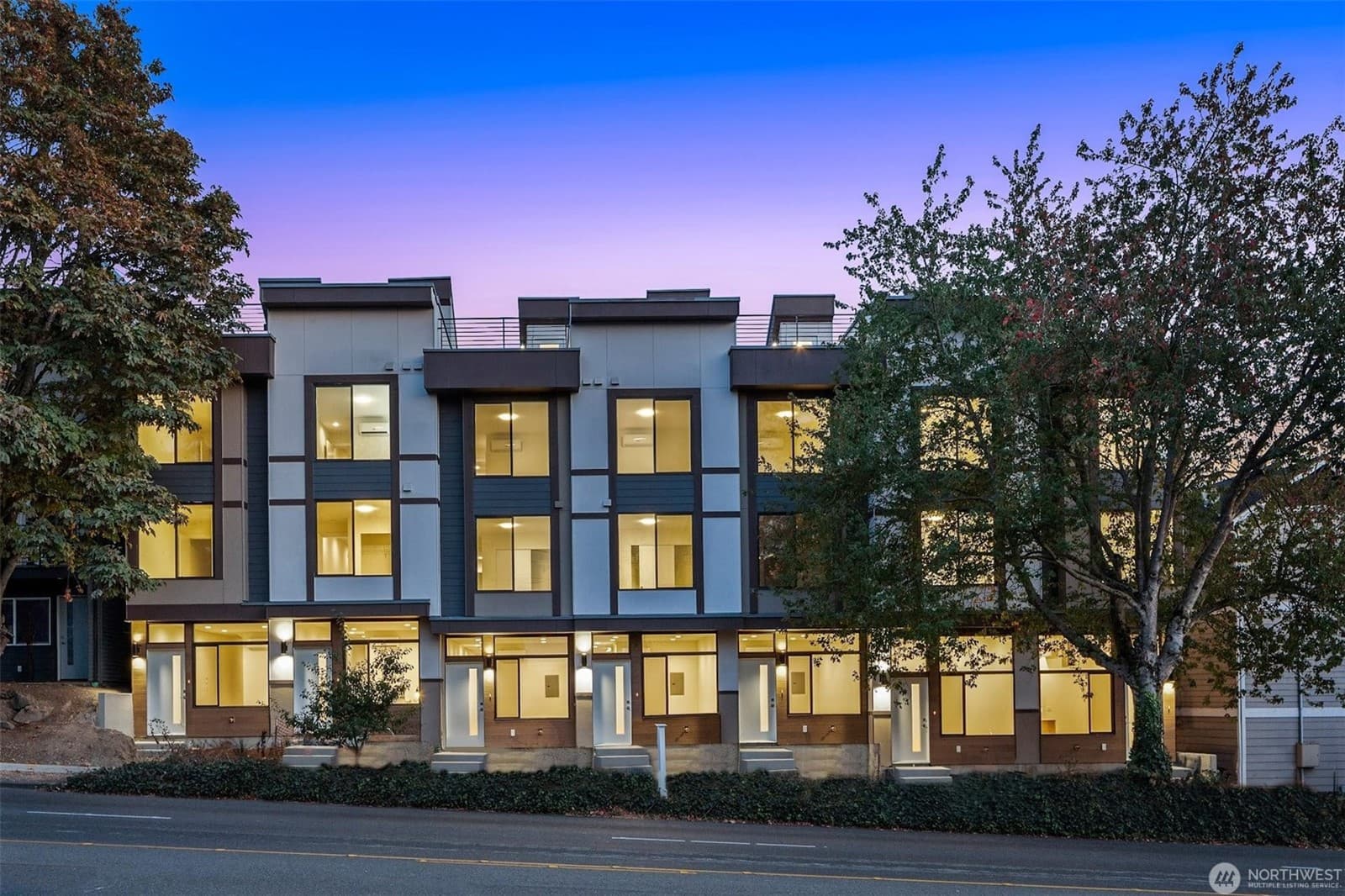
Over the past decade the arterials and the blocks around the commercial core have been rezoned for more density, and the result is visible on nearly every block: three-storey townhomes, usually in rows of four to eight, with rooftop decks and off-street parking. They are how most buyers get into Greenwood below the price of a detached house, and my guide to condos, townhouses and houses in Seattle lays out what they actually cost to own compared with the alternatives.
Two things to check on any Greenwood house that a listing will not tell you. North of N 85th Street, most streets have no sidewalks, because that was the county line until the 1954 annexation and the streets were built to a different standard; it changes how a block feels to walk and how the front yards drain. And on the blocks around the old bog, roughly the core of the neighborhood, the soil is peat, which can mean settling and drainage issues in older foundations. A good inspector knows to look. So does a good broker, and I would rather point it out before the offer than explain it after.
What Buying Here Looks Like
My buyer's home at 10152 Holman Road NW shows the townhome side of the neighborhood well: a three-storey, three-bedroom home of 1,349 square feet, with a full-floor primary suite, a roof deck looking out to the city and the Cascades, off-street parking, and Route 40 at the door. It is new construction of the kind that has filled in along Greenwood's arterials over the past decade, and it is a fair picture of what that stock offers relative to the close-in neighborhoods to its south: more finished space, newer systems, and a deck in place of a yard. The listing page has the details.
The client was relocating with their family, and their note afterward is the kind I keep: "Josh did a fantastic job! Very helpful through the entire process and attentive to the unique needs of my family. If I ever need to relocate again, I'll know exactly who to reach out to." If you are moving to Seattle from elsewhere, my relocation guide covers how to run that search from a distance, and Greenwood is a neighborhood I put on the list for people arriving without a car.
One more reason I put it on the list, and this one is personal. A few minutes from that townhome, at 606 N 105th Street on the neighborhood's north edge, is La Cabaña, a family-run Central American restaurant that is one of my favorite places to eat in Seattle. Pupusas, tamales steamed in banana leaves, plantains, pastelitos, and a molcajete worth planning a table around, from a menu that runs across El Salvador, Honduras, Guatemala, Nicaragua and Costa Rica. Neighborhoods are made of places like this, and Greenwood has more of them than its size suggests.
Who Greenwood Fits
It fits buyers who want a walkable main street without paying Ballard prices for it, who will actually use frequent buses, and who like a flat neighborhood with a library and a theatre at the end of the walk. It fits townhome buyers especially well, because the new stock here is plentiful and the commercial street gives a small home a big living room. It is less of a fit if you need a large lot, a view, or light rail at the door: the lots are city-sized, the neighborhood is flat, and the trains are a bus ride east.
If you want a straight answer on whether a specific block or house delivers the parts of Greenwood you actually care about, ask me. I have closed here, I know which side of which arterial is the quiet one, and the difference between a townhome row on a through-street and one on a side street is exactly what a listing photo will not show you. My free Buyer Guide covers costs, financing and what to check before you offer.
Quick answers
- Where exactly is Greenwood?
- Greenwood is in North Seattle, centered on the intersection of Greenwood Avenue N and N 85th Street. It runs from Phinney Ridge on the south, somewhere around N 80th, up to N 105th Street and Holman Road on the north, with Aurora Avenue N as its eastern edge and 8th Avenue NW and Crown Hill to the west.
- Is there light rail in Greenwood?
- No. Greenwood is a bus neighborhood, and a well-served one. Route 5 runs down Greenwood Avenue to downtown, the RapidRide E Line runs the length of Aurora, Route 45 along N 85th connects to the 1 Line at Roosevelt station and the U District, and Route 40 along Holman Road and N 105th reaches Northgate station one way and Ballard and downtown the other.
- What kinds of homes are in Greenwood?
- Mostly early-twentieth-century bungalows and Craftsman homes on the side streets, with 1950s ramblers mixed in, and a steady build-out of new three-storey townhomes along the arterials and near the commercial core over the past decade. The townhomes are how most buyers get into the neighborhood under the price of a detached house.
- Why do streets north of N 85th Street have no sidewalks?
- Because N 85th was Seattle's northern city limit until 1954, when everything up to N 145th was annexed. The streets north of that line were built to county standards, without sidewalks, and most still are. It is one of the first things to check when comparing two blocks that look otherwise similar.
- Why do buyers choose Greenwood over Ballard or Phinney Ridge?
- Usually because it delivers most of what they wanted from those neighborhoods, a walkable commercial street and frequent transit, at a price that leaves room for the house itself. Greenwood has been the next-door answer for buyers priced out of Ballard and Phinney Ridge for a long time, and its own main street is good enough that few of them feel like they settled.
Keep reading
- 01Mt. Baker: the full neighborhood guide
- 02Columbia City: the full neighborhood guide
- 03Beacon Hill: the full neighborhood guide
- 04Seward Park: the full neighborhood guide
- 05Hillman City: the full neighborhood guide
- 06Rainier Beach: the full neighborhood guide
- 07Othello: the full neighborhood guide
- 08Delridge: the full neighborhood guide
- 09Compare all seven Southeast Seattle neighborhoods