

Midcentury houses are all over the Seattle area, but the good ones are not spread evenly. They cluster in the places that were built out between the end of the war and the late 1960s, when Boeing was hiring, GI loans were cheap, and a generation of Northwest architects was designing houses for clients who wanted glass, wood and a view rather than a period costume. I live in a Kenneth Koehler house in Seward Park, and I have sold a midcentury home and helped buyers find one. This is the map I work from.
If you are new to the subject, start with my guide to midcentury modern homes in Seattle, which covers the architects, the South End, and what to inspect. This page is about where to look.
Three Kinds of Midcentury Neighborhood
Before the list, a distinction that changes how you hunt. The neighborhoods below fall into three rough types, and each one asks for a different search.
- 01Architect enclaves. A small, deliberately planned group of custom modern houses, often started by the architects themselves. The design quality is highest and the turnover is lowest. Hilltop in Bellevue is the regional example.
- 02Planned tracts. Hundreds or thousands of ranch and split-level houses from a single developer, built fast for postwar buyers. The design is more modest and more repetitive, and the condition and degree of remodeling vary enormously. Lake Hills is the big one.
- 03View neighborhoods built out after the war. Platted earlier, often with covenants and design review, and filled in mostly between 1945 and 1965. Here the custom moderns are scattered among ramblers, Cape Cods and traditional houses, and the architect-designed ones rarely announce themselves. Most of the city's best midcentury inventory lives in neighborhoods like this.
North Seattle
View Ridge and Wedgwood
HistoryLink's history of View Ridge traces it to 1935, when two former radio men, Al Balch and Ralph Jones, bought the land and platted it. Sales agreements required a committee to review building plans, and houses were set back to keep the views open. The area was annexed into Seattle in 1942 and built out through the 1940s and 1950s, so the stock is a mix: older cottages and Cape Cods, ramblers and split-levels from after the war, and a scattering of custom moderns among them.
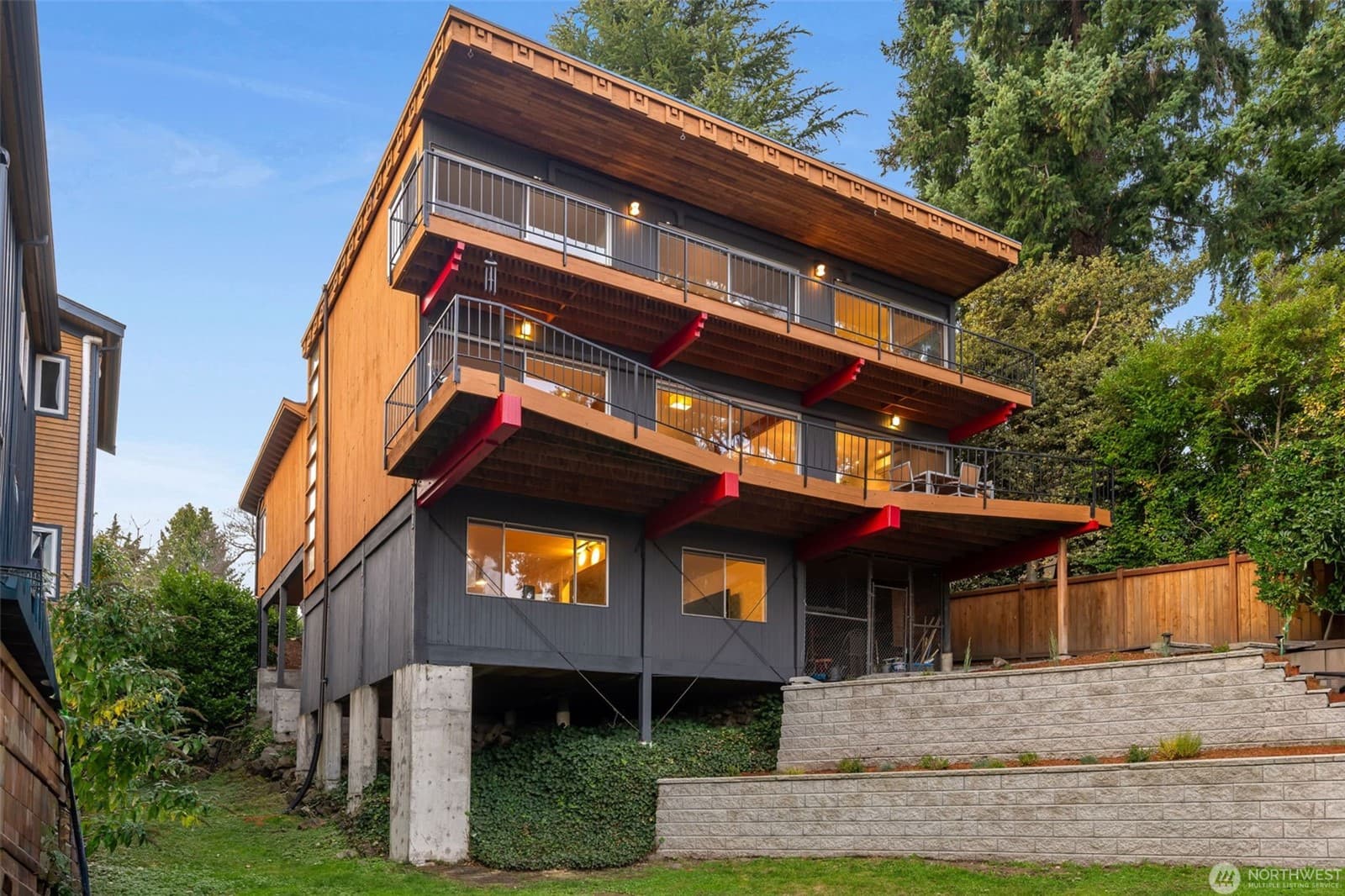
Wedgwood, next door, has its share of the custom work. Ralph Anderson's Glickman House, designed in 1959 and finished in 1960, sits above a ravine there, and Docomomo WEWA has opened it for tours. My buyers who came to me looking specifically for a midcentury home bought a 1964 house in View Ridge, which is a good example of what this part of the city can still produce: a design-forward house on an ordinary residential street.
Meadowbrook and the North End
Meadowbrook is where I listed the 1961 Van Slyck & Callison house that the Seattle Times named its Home of the Month in November 1961. It is three bedrooms and 1,810 square feet in the trees along Thornton Creek, with window walls, built-in seating in the living room and outdoor access from each bedroom, and sixty years of owners had left all of it intact. Dwell picked up the listing, it drew multiple offers on review day, and it sold in September 2025 for $1,295,000.
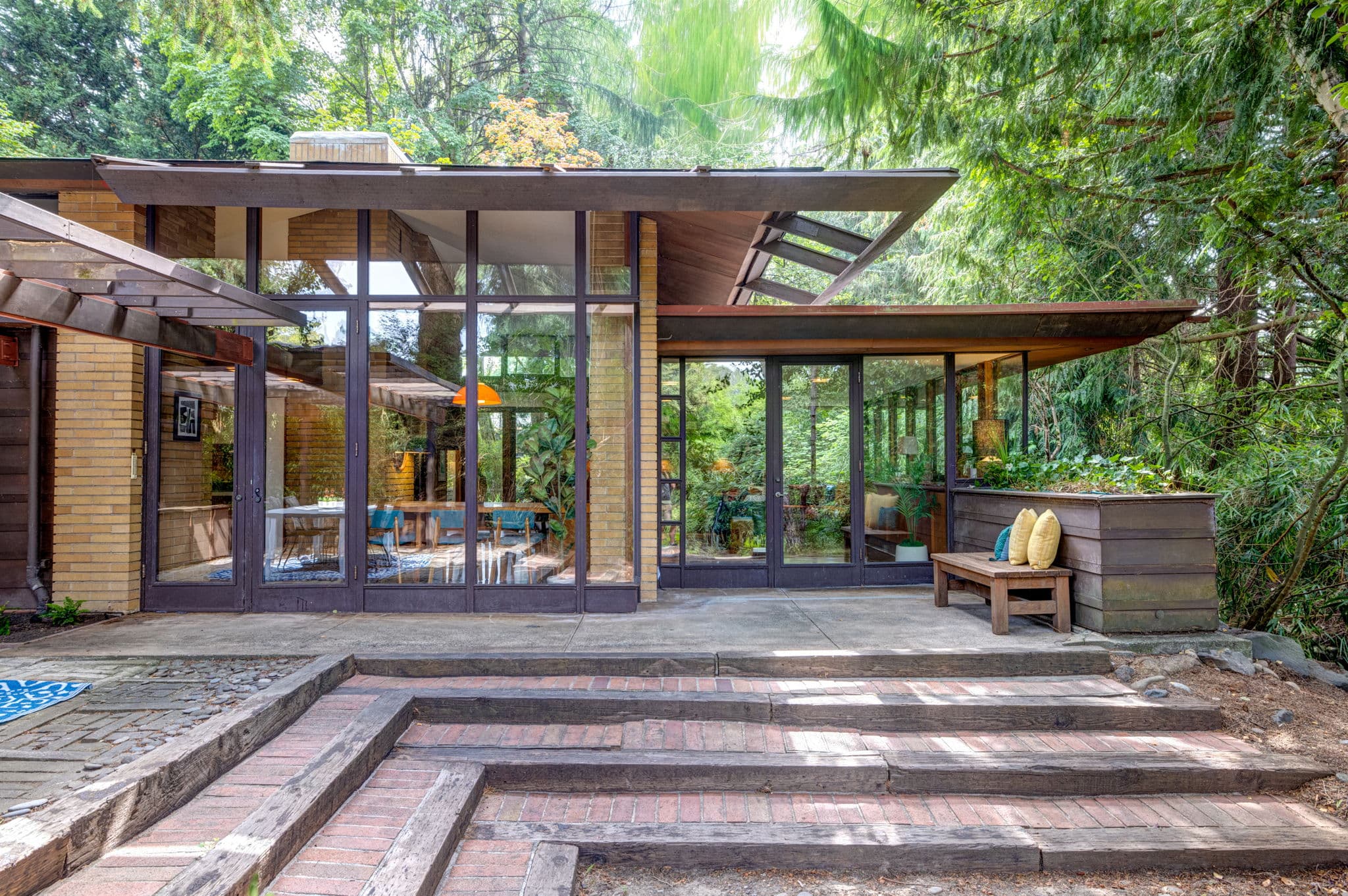
It is also a reminder that the North End east of I-5 has architect-designed houses tucked onto streets nobody would describe as a midcentury neighborhood. How that sale was marketed, and why it worked, is in my case study on selling a midcentury modern home in Seattle.
Blue Ridge
Blue Ridge, above Puget Sound next to Carkeek Park, was developed on land William Boeing bought in the 1920s. According to HistoryLink's Blue Ridge history, the land was logged and platted by 1932, more than half the lots were occupied by 1950, and nearly all were filled by 1960. That timeline is why it belongs on this list: a big share of its roughly 450 homes went up in the 1950s, among the earlier brick houses built for Boeing executives. Access to the community club, pool and private beach runs through the covenants.
Both Blue Ridge and View Ridge were sold with racially restrictive covenants, and HistoryLink documents both. Those clauses have been unenforceable since 1948, and Washington law now lets owners strike them from the record. They are worth knowing about as history, and they sometimes still appear in title documents.
Innis Arden, Shoreline
Just north of the city line, Innis Arden sits on a hill above the Sound on land the Boeing family had logged and platted, and it was developed after the war. It mixes original postwar houses with newer ones, and some of the originals are serious work, including a 1962 Ralph Anderson house with a double-height wall of glass. Expect view lots, mature trees and a lot of variation from street to street.
West Seattle
Fauntlee Hills
Fauntlee Hills, on the slope above Fauntleroy, is a small West Seattle pocket where many of the homes were built in the 1950s and early 1960s, a lot of them on lots looking toward the Sound. Its houses include a 1960 Paul Hayden Kirk design on Fauntlee Crest. Because the stock is relatively consistent, listings here are more likely than most to say what they are.
South Seattle
Seward Park, Lakeridge and Rainier Beach
The South End is the part of the map I know best, and it is covered in depth in the main guide: Koehler's Vista '63 house, Paul Hayden Kirk's Dowell House, Benjamin McAdoo's Ota Residence, and the everyday ramblers that make up most of the stock.
It is also where I live, in a Kenneth Koehler house. The things that drew me to it are the things to look for anywhere on this list: a long wall of glass under a low-pitched roof with deep overhangs, exposed posts and beams, and a plan stepped into the slope, with the garage tucked in below.
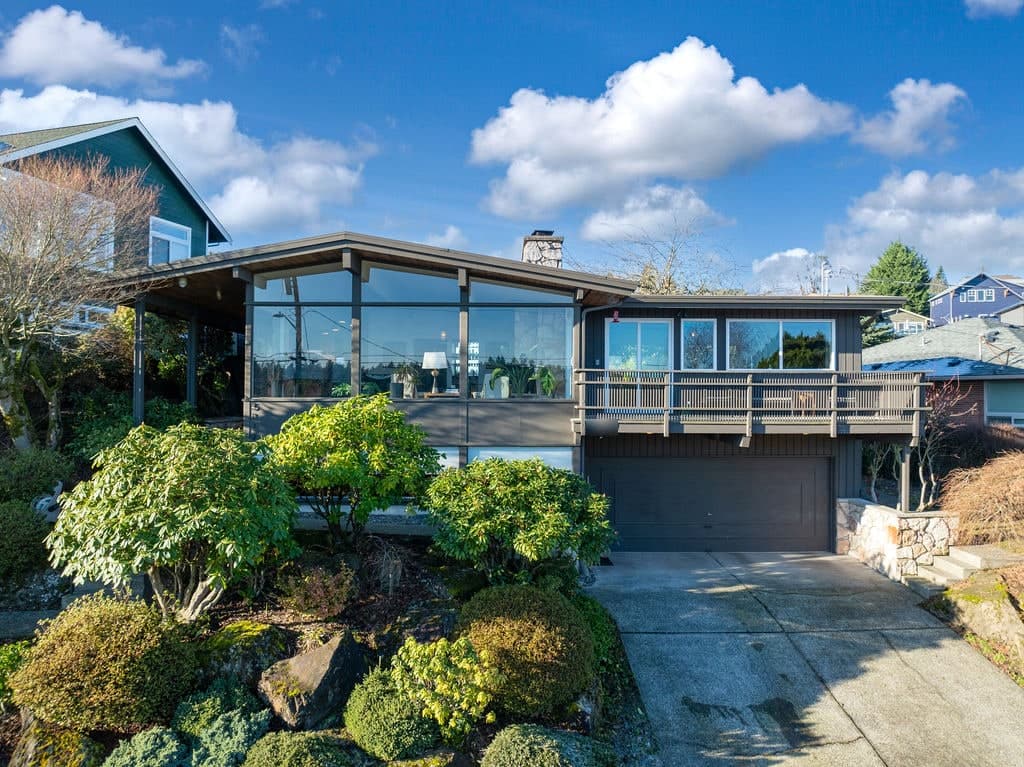
The short version for a search: Seward Park has midcentury ramblers on its interior streets and a few landmark houses near the lake, Lakeridge has individually designed midcentury moderns on its slopes, and much of Rainier Beach dates from the same era. This is where midcentury homes are most often listed without the word, and where watching the year built pays off most.
South of the City
Normandy Park
Normandy Park was planned in the 1920s as a French Norman-style community, then stalled in the Depression. HistoryLink's Normandy Park history describes a slow restart under the Normandy Park Company from 1939, and a steadier influx after Sea-Tac opened to civilian traffic in 1949 and Boeing grew. It incorporated in 1953, partly to keep control of its own zoning.
So the place that was meant to be Normandy cottages filled in with postwar houses instead, many on wooded or view lots toward the water. It has some of the region's most notable modern work, including Paul Thiry's 1962 Brauner House, which made the cover of Sunset in April 1967, and a Frank Lloyd Wright house. If you like Normandy Park, look at Seahurst just north of it in Burien too, where many of the homes are also midcentury.
The Eastside
Hilltop, Bellevue
Hilltop is the architect enclave of the region. It began in 1948 as a cooperative of 18 families, planned by three Seattle modernists, Perry Johanson, Fred Bassetti and John Morse, around a prospectus that applied modern planning to a wooded site. The University of Washington's architecture database lists a run of Morse houses there from the early 1950s, starting with his own in 1950, and Paul Hayden Kirk, Wendell Lovett and Roland Terry are among the other architects who built there.
It is a small, self-governing community, and houses come up rarely. If Hilltop is the goal, the honest advice is to set up a search, be ready to move, and be patient.
Lake Hills, Bellevue
Lake Hills is the opposite end of the spectrum. In 1954 developer Dick Connor assembled 1,200 acres for what HistoryLink describes as the Northwest's first planned residential community, modeled on Levittown. It opened in August 1955, and by 1963 it held about 4,000 ranch and split-level houses that started at around $13,000 each. Bellevue annexed it in 1969.
Lake Hills is midcentury by date more than by design pedigree, and decades of remodeling mean two houses built from the same plan can be worlds apart today. The appeal is a big, coherent stock of single-level postwar houses around the Lake Hills Greenbelt. The find is the one whose original layout, beams and details have survived.
How to Hunt for a Midcentury Home in Each One
The type of neighborhood decides the strategy.
- 01In an enclave, the problem is supply. Houses come up rarely, sometimes quietly, so the job is a standing search and an agent who hears about things early.
- 02In a tract, the problem is condition. Learn what the original houses looked like, so you can tell a well-kept original from a flip that has stripped out what you came for. Pricing here follows the ordinary comps, not the design.
- 03In the mixed view neighborhoods, the problem is that the listing will not tell you. Search by year built, roughly 1948 to 1968, and scan descriptions for post and beam, clerestory windows, tongue and groove ceilings, radiant heat, or an architect's name. Then look at the photos, because a lot of these houses are listed as a three-bedroom rambler and nothing more.
Wherever you end up, inspect for what these houses do differently: low-slope roofs, single-pane glass, radiant heat, and exposed beam ends that have taken the weather for sixty years. The checklist is in the main guide.
Looking in One of These Neighborhoods?
I watch for midcentury houses across the city and both sides of the lake, including the ones that never get called midcentury in the listing. I sold the Van Slyck, one of the most widely covered midcentury listings in Seattle, and I represented the View Ridge buyers who came to me looking for exactly this. If you are hunting for one, or own one and wonder what it is worth, I would be glad to talk.
Quick answers
- Which Seattle neighborhoods have the most midcentury modern homes?
- Inside the city, look at View Ridge and Wedgwood, Blue Ridge, Fauntlee Hills in West Seattle, and Seward Park, Lakeridge and Rainier Beach in the South End. Just outside it, Normandy Park, Innis Arden in Shoreline, and Hilltop and Lake Hills in Bellevue all have deep postwar stock. They differ a lot: some are architect-designed enclaves, some are planned tracts of ranch houses, and most mix a few custom moderns in among ordinary ramblers.
- Is Lake Hills in Bellevue midcentury modern?
- Lake Hills is midcentury in date rather than in design pedigree. It opened in 1955 as a planned community and had about 4,000 ranch and split-level houses by 1963. Many have been remodeled, some heavily. An unaltered one with its original layout and details is the find, and they are worth knowing how to spot.
- How do I search for midcentury modern homes for sale in Seattle?
- Do not rely on the word midcentury in a listing, because many sellers and agents never use it. Search by year built, roughly 1948 to 1968, in the neighborhoods where the stock clusters, and scan for words like post and beam, clerestory, tongue and groove, radiant heat, or an architect's name. Then set up an alert so you see new listings the day they hit.
- Do midcentury homes in architect-designed enclaves ever come up for sale?
- Yes, but rarely, and some sell quietly before they reach the open market. In a place like Hilltop in Bellevue the turnover is low enough that the practical approach is patience, a saved search, and an agent who is watching for it.