
 Facebook
 X
X
 Pinterest
 Copy Link
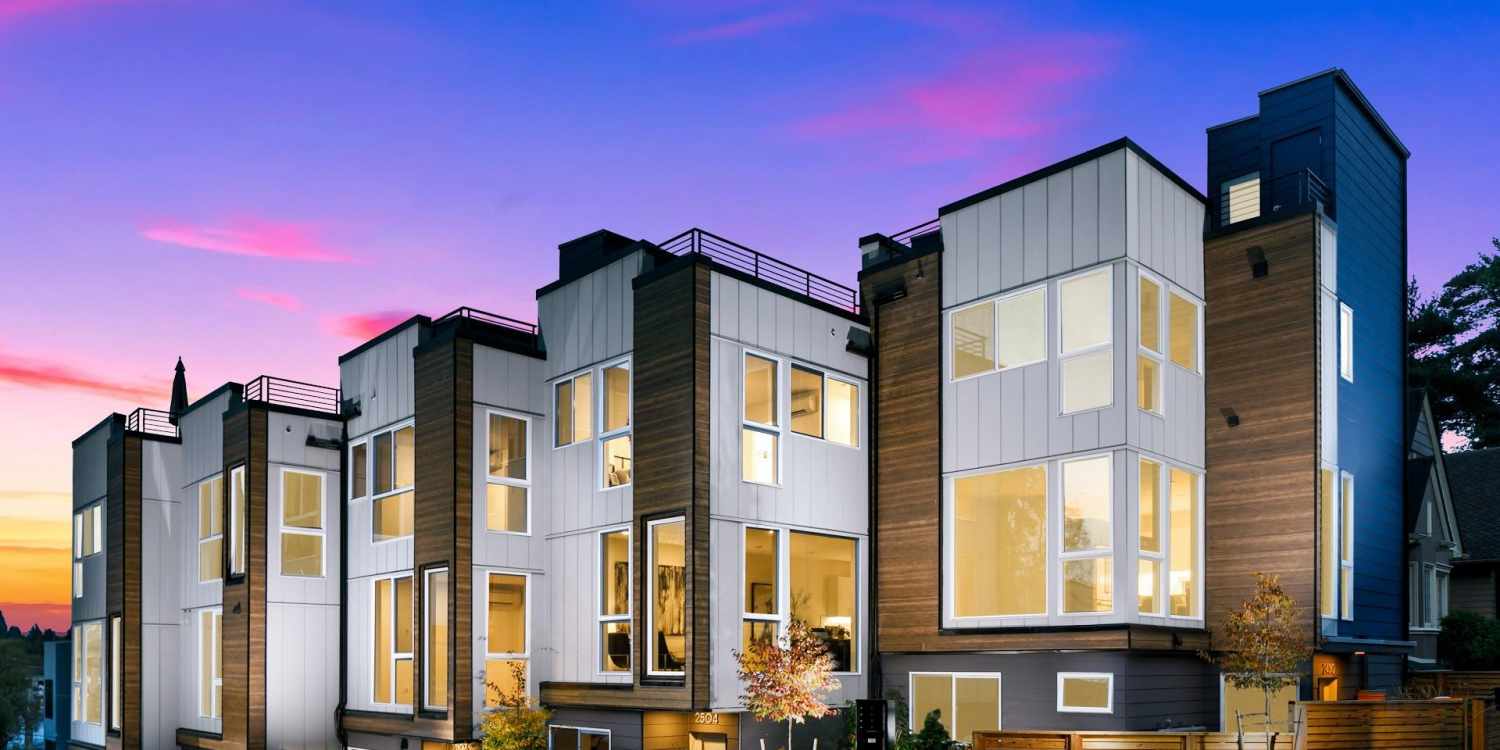
“Should I buy a condo or a townhouse?” is one of the most common questions Seattle buyers ask, and the honest answer is that it depends less on the building than on the math behind it. On paper, a condo, a townhouse, and a single-family house can look like three versions of the same thing: a place to live with your name on the title. In practice, they are three different financial products, each with its own ownership structure, monthly costs, and resale story. Here is how they actually compare in Seattle in 2026, and how to tell which one fits your budget and your plans.
Three Different Ways to Own
Before comparing price tags, it helps to know what you are actually buying. A condominium means you own the interior of your unit, the “air space,” while the building, roof, grounds, and shared systems belong to the homeowners association that every owner funds together. A townhouse in Seattle is usually fee-simple, which means you own the structure and the land underneath it, wall to wall, much like a house. Many newer townhouses have no HOA at all, just a shared “party-wall” agreement between neighbors that spells out who maintains the wall you have in common. A single-family house is the simplest form: you own the home, the lot, and everything on it, and you answer to no association. That difference in structure, not the square footage, is what drives most of the cost gaps below.
What Each One Costs in Seattle in 2026
Seattle is really several markets moving at different speeds right now. The citywide median sale price sits around $879,000, down about 2.3% from a year ago, but the spread by property type is wide. Single-family houses remain the most expensive, frequently above $1 million once you are inside the city. Townhouses are the middle path: a brand-new three-bedroom townhouse of roughly 1,500 square feet in a popular neighborhood typically lists in the $700,000s to low $800,000s. Condos are the entry point, with a median closer to the mid-$400,000s to high-$500,000s depending on the building and location.
Here is the part worth noting in 2026: condos have fallen the furthest. Condo prices dropped by roughly 9% to 13% year over year, the largest decline of any property type, while houses held closer to flat. For a buyer, that softness is opportunity. Condos in the $500,000 to $700,000 range have become the main on-ramp for first-time buyers, and sellers in that segment are far more willing to negotiate than house sellers in the same neighborhood.
The Monthly Cost Almost Nobody Budgets For
Purchase price is only half the comparison. The other half is the monthly dues, and this is where condos and townhouses split sharply. Seattle condo HOA fees commonly run from about $400 to well over $1,500 a month, with mid-rise and high-rise buildings averaging somewhere in the $600 to $1,350 range. Those dues cover real things, such as the roof, the elevator, exterior insurance, and shared amenities, but they also never stop and tend to rise over time.
Townhouses tell a very different story. Many Seattle townhouses carry no HOA at all, and those that do average around $350 a month, often far less. Newer-construction townhouses frequently charge only a token amount, sometimes between $1 and $100 a month, because there is little shared property to maintain. Run the math before you fall for a sticker price: a condo listed $100,000 cheaper than a townhouse can cost you more every month once a $900 HOA payment is in the picture, and that payment does not build equity.
Financing: Why a Condo Can Be Harder to Buy Than a House
A condo is the one property type where the building can disqualify you, even if your finances are perfect. Lenders treat condos differently because you are tied to the financial health of the whole association. The key word is “warrantable.” A warrantable building meets Fannie Mae and Freddie Mac standards, so you can use a conventional, FHA, or VA loan with a normal down payment. A non-warrantable building does not, and then you often need 20% down or more, at a higher rate.
Several things can flip a building to non-warrantable: active or pending litigation, one investor owning too large a share of the units, thin reserves, or a large pending special assessment. FHA currently expects associations to put at least 10% of the annual budget toward reserves, and Fannie Mae is moving toward a 15% standard in 2027, so underbudgeted buildings are getting harder to finance, not easier. The practical takeaway is that with a condo you are underwriting two things at once: yourself and the HOA. Always read the resale certificate, the reserve study, and the meeting minutes before you remove your financing contingency.
Townhouses and houses skip almost all of this. Because a fee-simple townhouse is financed much like a single-family house, there is no building approval to clear and no association balance sheet for your lender to scrutinize. For many buyers, that simplicity is the quiet reason a townhouse beats a similarly priced condo.
The Seattle Wrinkle: Why There Are So Few New Condos
If it feels like every new building in your search is townhouses and apartments rather than condos, you are not imagining it. For decades, Washington’s condominium warranty law made it relatively easy to sue developers over construction defects, and the resulting litigation, plus the insurance to guard against it, made condos risky to build. Developers report paying anywhere from $5,000 to $35,000 per unit just for defect insurance, and they pass that cost straight into prices. The result is a city where townhouses filled the gap that condos left behind, which is exactly why townhouses dominate Seattle’s entry and middle price bands today. Recent reform efforts aim to loosen this up, but the supply imbalance is still very real in 2026.
So Which One Is Right for You?
Choose a condo if you want the lowest purchase price, a lock-and-leave lifestyle, or a location, such as downtown or a dense urban core, where condos are the only option. Just budget honestly for the dues and vet the building hard. Choose a townhouse if you want most of the benefits of a house, your own front door, ground to stand on, and simpler financing, without a million-dollar price tag. For buyers in the $600,000 to $850,000 range, the townhouse is often the sweet spot. Choose a single-family house if you need maximum space, a real yard, long-term control over the property, and the strongest historical appreciation, and your budget can reach into seven figures.
Quick Answers
Is a condo or townhouse a better investment in Seattle? Houses have appreciated the most historically, and townhouses have tracked closely behind. Condos have lagged, which is part of why they look relatively cheap right now. If you plan to stay several years, the lower entry price of a condo can still pencil out, especially in a softer market.
Do townhouses have HOA fees? Sometimes, but often not. Many Seattle townhouses have no HOA, and those that do usually charge far less than a condo, frequently under $100 a month for newer construction.
Why is it harder to get a loan on a condo? Because your lender approves the building as well as you. Litigation, low reserves, heavy investor ownership, or a big special assessment can make a condo non-warrantable and force a larger down payment.
What is a special assessment? A one-time charge an HOA levies when reserves fall short of a big repair, such as a new roof or facade work. It can run from a few hundred to tens of thousands of dollars, so always review the reserve study before buying a condo.
Can first-time buyer programs be used on all three? Yes. Washington down payment assistance and first-time buyer programs apply to condos, townhouses, and houses alike, which keeps every option on the table.
The Bottom Line
Do not shop by sticker price alone. A condo, a townhouse, and a house at the same purchase price can carry wildly different monthly costs, financing hurdles, and resale outcomes. In 2026, softer condo prices have created genuine value for the right buyer, while townhouses remain the practical middle ground for anyone who wants house-like ownership without a house-like price. The smart move is to compare the full monthly picture, dues included, and to read the building documents before you commit.
Want help running the numbers on a specific listing? My free Seattle Buyer Guide walks through costs, financing, and what to check before you offer, and if you are leaning toward attached homes, start with my guide to buying a townhouse in Seattle or browse current condo listings to see what your budget buys today.
Reach Out
If you’re the least bit curious, please email, text, or call me. I would love to connect!
