

When a midcentury house in Seattle comes up for sale, the first question a design-minded buyer asks is who designed it. Often the listing does not say, and sometimes nobody knows. But a surprising number of the region's postwar houses were designed by a fairly small group of architects, many of whom trained at the University of Washington, worked in each other's offices, and built for the same kinds of clients in the same neighborhoods.
This is a field guide to them: who they were, what their houses tend to look like, and where to find their work. I live in a house by one of the less famous ones, Kenneth Koehler, and my guide to midcentury modern homes in Seattle tells his story in full. For where these houses cluster, see where to find midcentury modern homes in Seattle.
What They Had in Common
Most of these architects worked in what came to be called the Northwest Regional style. It took the ideas of European and California modernism and adapted them to a wet, forested, hilly place with cheap, beautiful lumber. Across very different personalities, the houses share a recognizable vocabulary:
- 01Post-and-beam wood construction, which frees the walls from carrying the roof and makes room for glass.
- 02Broad windows and window walls facing a view, a garden or the woods, often with clerestories tucked under the roofline.
- 03Low-pitched or flat roofs with deep overhangs, because it rains here for half the year.
- 04Exposed framing, natural wood and stone, inside and out.
- 05A plan shaped around the site, set into the slope and turned toward the view, rather than squared to the street.
They also had an unusual promotional engine. From the 1950s the Seattle Times and the local chapter of the American Institute of Architects ran a Home of the Month program that put architect-designed houses in front of ordinary newspaper readers every month. Many of the houses below were featured, and that recognition is still one of the best ways to trace a house's designer today.
The Architects
Paul Thiry
Paul Thiry (1904 to 1993) is usually credited with bringing European modernism to Seattle. Born in Nome, Alaska, he graduated from the University of Washington in 1928 and opened his own practice the next year. A trip abroad in the early 1930s, where he met Le Corbusier, turned him toward modernism, and his own house of 1936 in Washington Park is often cited as a landmark of early modernism in the city. He went on to be principal architect of the 1962 World's Fair. His houses are rarer than the later architects' and they are among the most significant: the 1962 Brauner House in Normandy Park made the cover of Sunset in 1967.
Paul Hayden Kirk
If one name defines the Seattle midcentury house, it is Paul Hayden Kirk (1914 to 1995). He opened his practice in 1939, and his 1950s and early 1960s houses moved from flat roofs and bands of windows toward the complex, exposed wood framing he is best known for. His Lewis Dowell House in Seward Park is one of the South End's landmarks. Kirk also designed University Unitarian Church, the Magnolia branch library, and the University of Washington Faculty Center with Victor Steinbrueck, and Ralph Anderson worked in his office before going out on his own. Look for his houses in Seattle, Bellevue, Mercer Island and The Highlands.
Roland Terry
Roland Terry (1917 to 2006) brought a richer, warmer palette to the regional style: rugged stone, broad beams, angled glass and borrowings from Japanese architecture. He is best known for Canlis, the restaurant above Lake Union, and he designed houses for some of the region's most prominent families, on Lake Washington, Hunts Point and Bainbridge Island. He practiced as Terry & Moore from 1952 and later under his own name. Terry houses tend to be larger and more polished than most on this list, and they rarely come up for sale.
Fred Bassetti and John Morse
Fred Bassetti (1917 to 2013) studied at Harvard under Walter Gropius and Marcel Breuer, and in 1947 he and John Morse formed Bassetti & Morse. The two of them, with Perry Johanson, planned the Hilltop community in Bellevue in 1948, and the firm's early houses there and around the region are classic wood-framed Northwest modern. Bassetti later became one of Seattle's major institutional architects, with the Henry M. Jackson Federal Building and the Seattle Municipal Tower, but his residential work from the Bassetti & Morse years is the part house hunters care about.
Wendell Lovett
Wendell Lovett (1922 to 2016) studied with Alvar Aalto at MIT, worked at Bassetti & Morse, and opened his own office in 1951, the same year he built his first house at Hilltop. He taught at the University of Washington for decades. His early work is crisp and geometric, influenced by Mies and California's Case Study houses; his later houses grow more sculptural. His work won the Seattle Times/AIA Home of the Year more than once, and much of it is on the Eastside, in Bellevue and on Mercer Island.
Ralph Anderson
Ralph Anderson (1924 to 2010) grew up in Seattle, studied at the University of Washington on the GI Bill, worked for Paul Hayden Kirk, and opened his own practice in 1954. Docomomo WEWA's profile sums up his signature well: broad windows, hovering protective rooflines, exposed framing and an emphasis on verticality, often on a T-shaped plan aimed at a water or mountain view. He joked that he was the poor man's Roland Terry. His houses are scattered across Seattle, including the Glickman House in Wedgwood, and south to Normandy Park.
Gene Zema
Gene Zema (born 1926) graduated from the University of Washington in 1950 and ran his own practice from an office in Eastlake from 1953 until he retired in 1976. His own house in Sheridan Heights, in Lake Forest Park, won the first Seattle AIA Home of the Year in 1955, and his Lupton Residence on Mercer Island was the 1961 Seattle Times/AIA Home of the Year. His work leans on natural materials, views and a Japanese sensibility. Look for it in north Seattle, Lake Forest Park, Shoreline, Mercer Island and Bellevue.
Benjamin F. McAdoo
Benjamin McAdoo (1920 to 1981) earned his architecture degree at the University of Washington in 1946, and HistoryLink describes him as the first African American architect to maintain a practice in Washington. His designs were first published in the Seattle Times in 1949, and his houses combine modernism and regionalism: open structures, generous glass and strong horizontal lines tying them to the site. His Ota Residence in Rainier Beach, from 1955 to 1956, blends midcentury modern with traditional Japanese design. McAdoo was also president of the Seattle chapter of the NAACP.
Kenneth Koehler
Kenneth Koehler (1920 to 1981) is the architect of my own house, and the one on this list most rooted in the South End. He built his practice in the Rainier Valley from 1950, chaired the AIA's Home of the Month committee in the late 1950s, and designed houses, apartments and civic buildings from Normandy Park to Issaquah. His best-known house is the Vista '63, built inside the Washington Coliseum for the 1963 home show and later moved to Seward Park. The full story is in my main guide.
Van Slyck & Callison
Gerald Van Slyck and Tony Callison practiced together as Van Slyck & Callison from 1960 to 1965. Callison went on to found the Callison Partnership in 1974, which grew into one of Seattle's largest firms, but the early houses are the ones that matter here. I listed one: a 1961 Van Slyck & Callison house in Meadowbrook that was the Seattle Times Home of the Month in November 1961, and that kept its window walls, built-ins and brick fireplace for more than sixty years.
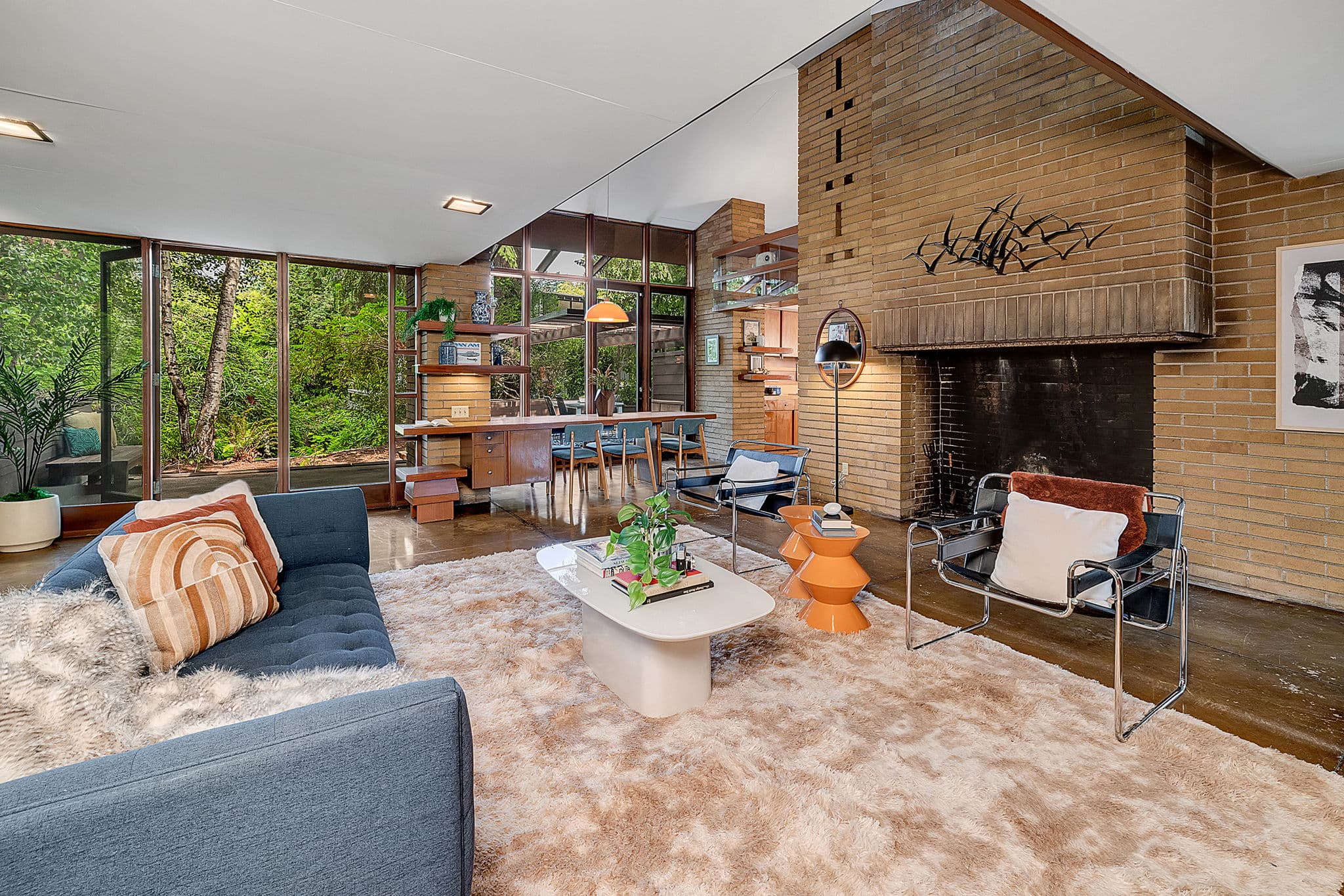
How we marketed it, and why naming the architects mattered, is in my case study on selling a midcentury modern home in Seattle.
A Quick Field Guide
| Architect | Active | What to look for | Where to look |
|---|---|---|---|
| Paul Thiry | 1929 onward | Early, crisp European modernism; concrete and stucco as well as wood | Washington Park, Normandy Park |
| Paul Hayden Kirk | 1939 to 1979 | Layered, exposed wood framing; refined structure | Seattle, Bellevue, Mercer Island |
| Roland Terry | 1946 to 1987 | Stone, broad beams, angled glass, Japanese touches | Lake Washington shores, Bainbridge |
| Bassetti & Morse | 1947 to 1962 | Classic wood-framed Northwest modern | Hilltop in Bellevue, Seattle |
| Wendell Lovett | 1951 onward | Crisp geometry early, sculptural later | Bellevue, Mercer Island |
| Ralph Anderson | 1954 onward | Hovering rooflines, T-shaped plans, verticality | Seattle, Normandy Park |
| Gene Zema | 1953 to 1976 | Natural materials, views, Japanese sensibility | North Seattle, Lake Forest Park, Mercer Island |
| Benjamin McAdoo | 1947 onward | Strong horizontals, generous glass | South Seattle, south King County |
| Kenneth Koehler | 1950 to 1981 | Practical, view-oriented post and beam | Seward Park, Rainier Valley |
The dates are the span of each architect's practice, not of their houses alone, and none of these traits is a signature on its own. Plenty of builders borrowed the look. Treat them as reasons to look further, not as proof.
How to Find Out Who Designed a House
A confident attribution is worth having, both when you buy and when you sell. These are the places I look:
- 01The original permit and plans. The city keeps building permits and, for many older houses, the drawings, and the architect's name is usually on the sheets.
- 02The University of Washington's Pacific Coast Architecture Database, which lists thousands of Northwest buildings by architect, address and original owner.
- 03Docomomo WEWA's architect records, which often name individual houses and original clients.
- 04The Seattle Times/AIA Home of the Month archive. A house that was featured has a published date, a name and usually a photograph.
- 05Previous listings, and the original owners' families. Many of these houses were commissioned by the people who lived in them for decades, and the family often knows exactly who designed it.
What an attribution is worth depends on whether the house still shows it. A documented Kirk or Anderson house with its framing, glass and plan intact draws a different buyer than the same house remodeled past recognition.
Looking for an Architect-Designed House?
The houses on this list rarely come up, and when they do the listing often leaves out the most interesting fact about them. I watch for them across the city and the Eastside, and I know what to check before anyone pays for a name. If you are hunting for one, or you own one and want to know what its history is worth, I would be glad to talk.
Quick answers
- Who were the most important midcentury modern architects in Seattle?
- The names that come up most often are Paul Thiry, Paul Hayden Kirk, Roland Terry, Fred Bassetti and John Morse, Wendell Lovett, Ralph Anderson, Gene Zema and Benjamin McAdoo. Behind them is a deeper bench of architects whose houses are just as good and far less known, including Kenneth Koehler and the firm of Van Slyck & Callison.
- What is the Northwest Regional style?
- It is the Pacific Northwest's version of midcentury modern: post-and-beam wood construction, broad windows, low roofs with deep overhangs to shed the rain, exposed framing, natural wood and stone, and a plan shaped around the site and the view rather than the street.
- How do I find out who designed my Seattle house?
- Start with the original building permit and plans, which the city keeps for many older houses. Then search the University of Washington's Pacific Coast Architecture Database and Docomomo WEWA's architect records by address or original owner, and check whether the house was ever a Seattle Times/AIA Home of the Month. Previous listings and the original owners' families are often the last piece of the puzzle.
- Does an architect's name add value to a midcentury house?
- It can, because it widens the pool of buyers to people shopping for the design itself. The name has to be documented and the house has to have kept the qualities the architect gave it. An attribution nobody can verify, or a house remodeled past recognition, adds little.